
In industrial environments where there is a risk of flammable gases, vapors, dust, or combustible fibers, the use of standard electrical equipment can be catastrophic. **Explosion-Proof Motors (Ex Motors)**, also known as **Explosion-Proof Electric Motors**, are specifically designed and manufactured to operate safely in these hazardous areas.
These motors ensure the highest level of safety by preventing dangerous elements from entering the enclosure and by blocking the transfer of heat or sparks that could ignite the surrounding atmosphere. **Selecting and purchasing an explosion-proof motor** is not merely a choice but a safety and legal necessity in industries such as oil, gas, petrochemicals, pharmaceuticals, mining, and more.
One of the first concerns of engineers and procurement managers is obtaining an up-to-date and fair price list for explosion-proof electric motors. Due to currency fluctuations and the technical nature of this product, providing a fixed price is not possible, and prices are determined daily through inquiries.
| Main Influencing Factor | Description |
| Output Power (kW/HP) | The most important factor; the higher the motor power (horsepower or kilowatts), the higher the price will be. |
| Explosion-Proof Class (Zone/Group) | The required protection type and hazardous area classification (such as Zone 0, 1, 20, 21). Motors with higher protection levels (like Zone 0 or 20) are generally more expensive than Zone 2 motors due to their more complex design. |
| Protection Degree (IP Rating) | The level of the motor’s resistance against the ingress of solid objects and liquids. Motors with higher IP ratings (e.g., IP66) that are better sealed cost more. |
| Brand and Country of Manufacture | Reputable international brands (such as ABB, Siemens) or domestic brands (such as Jamco) offer different prices depending on their reputation, material quality, and certifications. |
| Body and Shaft Material | Using special materials such as stainless steel for highly corrosive chemical or marine environments increases the final cost. |
| Cooling Technology (IC) | Special cooling methods (such as compressed air ventilation or specific Ex-proof cooling designs) can increase the price due to manufacturing complexity. |
Using these devices in hazardous environments not only meets legal requirements but also provides the following essential advantages:

Protection of Life and Property (Maximum Safety): The most important advantage is preventing explosions and fires in the workplace.
Increased Operational Stability: These motors are designed to maintain long lifespan and stable performance under harsh environmental conditions (temperature, humidity, corrosive substances).
Reduced Insurance Costs: Compliance with standards and the use of safe equipment significantly lowers accident and asset insurance expenses.
Global Standards: Compliance with ATEX, IECEx, UL, and other standards enhances your facility’s industrial credibility.
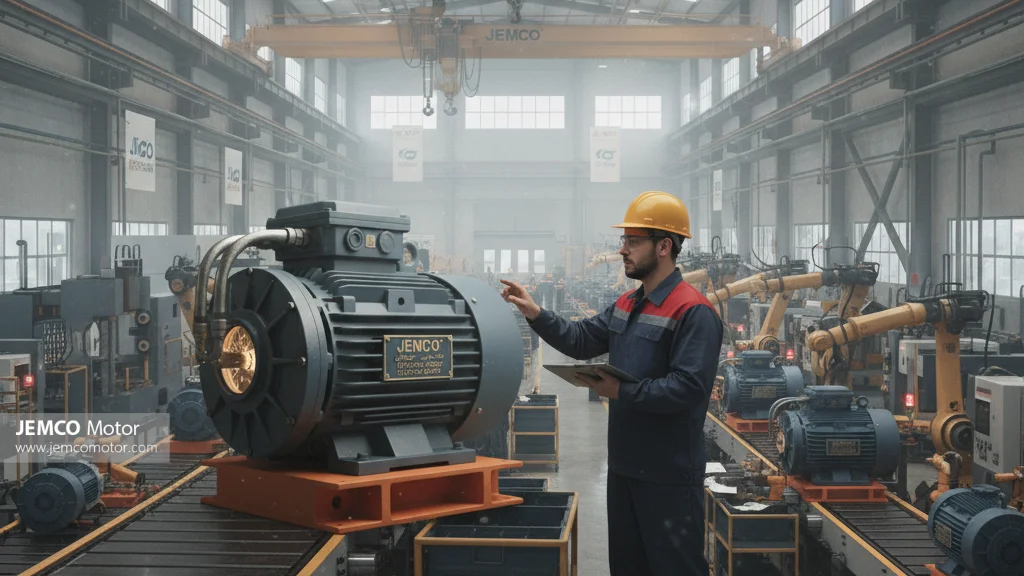
According to international regulations, installing any non-EX motor in Zones 0, 1, 20, and 21 is strictly prohibited and considered a violation.
Purchasing an explosion-proof electric motor is a strategic decision for the following industries:
| Industry | Common Application | Hazardous Factors |
| Oil, Gas, and Petrochemical | Pumps, compressors, fans, mixers | Methane gas, propane, hydrocarbons |
| Mining (Coal) | Conveyors, drilling equipment, ventilation | Methane gas, coal dust |
| Pharmaceutical and Chemical | Reactors, mixers, solvent pumps | Alcohol vapors, acetone, pharmaceutical dust |
| Flour & Grains (Food Industry) | Mills, silos, conveyors | Flour dust, grain dust, organic powders |
| Paint & Coating | Transfer pumps, paint mixers | Organic solvent vapors |
Standardization of explosion-proof motors is based on the type and probability of hazardous substances present in the environment:
| Zone | Hazard Level | Description |
| Zone 0 | Continuous | The gas/air mixture is continuously or for long periods present. (Highest level of protection) |
| Zone 1 | Frequent | During normal operation, the gas/air mixture is likely to occur. |
| Zone 2 | Rare | The gas/air mixture rarely occurs and only for short periods. (Lowest level of protection) |
Zone 20: Inside silos and storage tanks (dust present as a continuous cloud).
Zone 21: Areas near discharge points (likely to occur under normal conditions).
Zone 22: External areas around equipment (occurs rarely and for short periods).
AC electric motors are among the most widely used types of electric motors in various industries. Due to their high efficiency, long service life, and stable performance, they are used in production lines, pumping systems, ventilation, and many industrial devices. These motors are manufactured in different power classes and speeds to meet diverse industrial needs.
If you intend to buy an AC electric motor, you can review the available models on this page, compare the technical specifications of each product, and choose the most suitable option based on operating conditions and application type.
When reviewing the technical specifications of an explosion-proof electric motor, the following parameters should be considered:
| Technical Feature | Specialized Description |
| Power and Speed | Output power (kW/HP) and rated speed (RPM), indicating the motor’s strength and rotational speed; such as 4-pole motors (1500 RPM) or 2-pole motors (3000 RPM). |
| Temperature Class | The maximum allowable surface temperature at the hottest point of the motor. This class (from T1 to T6) ensures that the motor’s temperature will not ignite hazardous substances in the environment. |
| Protection Type | The enclosure design used to withstand explosion risk. Common types include Ex d (flameproof enclosure), Ex e (increased safety), and Ex i (intrinsically safe). |
| IP Rating | The motor’s resistance to the intrusion of solid objects and water. For example, IP55 indicates protection against dust and water jets. |
| Insulation Class | The maximum allowable temperature of the windings before insulation damage occurs. Classes F and H are commonly used, indicating high thermal endurance. |
| Efficiency | The motor’s efficiency in converting electrical energy into mechanical power, defined by IEC standards with codes such as IE2, IE3, or IE4 (super-premium efficiency). |
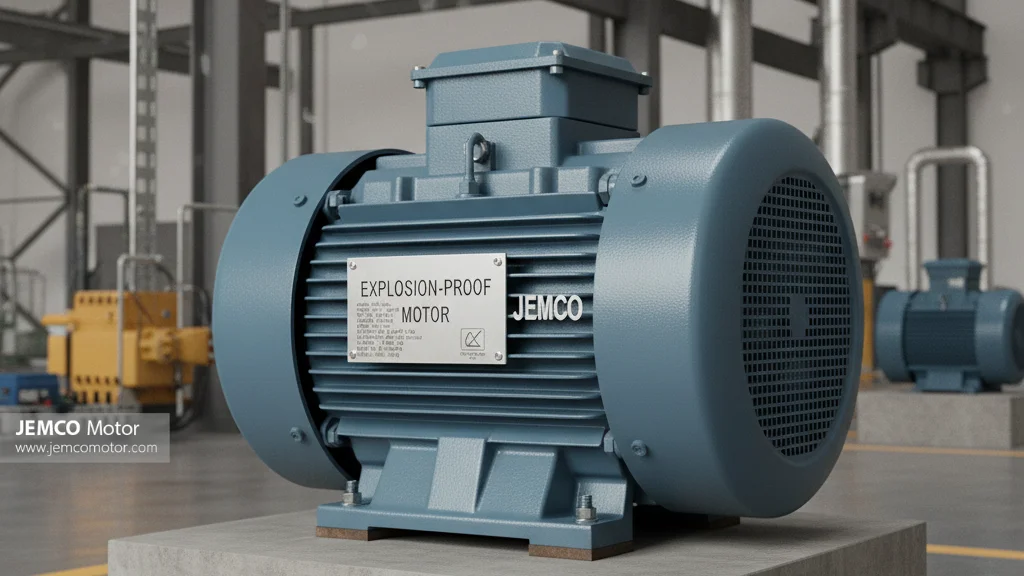
Reinforced Enclosure: Designed to withstand internal explosion pressure and prevent flame or spark propagation to the outside.
Explosion-Proof Cable Glands (Ex Cable Glands): Used for sealing cable entry points and preventing ingress.
Nameplate: Contains complete standard information (e.g., II 2G Ex d IIC T4).
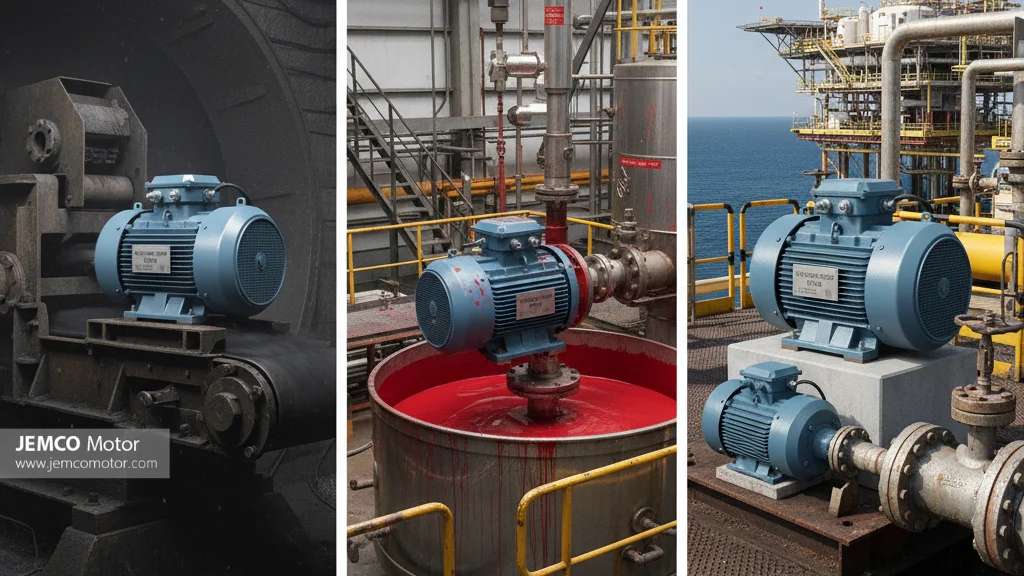
Selecting the right EX motor requires careful attention to environmental and technical parameters. Jemco Motor specialists summarize this process in three steps:
The type of hazardous substance (Gas IIC, IIB, IIA / Dust IIIC, IIIB, IIIA).
The hazardous zone (Zone 0, 1, 2 / Zone 20, 21, 22).
The temperature class (T-Class) of the environment.
Power and Speed: Must match the mechanical requirements of the pump or fan.
Voltage and Frequency: Must match the power supply (e.g., three-phase explosion-proof motor 380V/50Hz).
Mounting Type and Frame Size: Based on the equipment’s dimensions and connection method (e.g., B3, B5).
Once you have the exact technical specifications, contact the Jemco Motor sales department to receive the price list for explosion-proof motors and delivery time.
Jemco industrial electric motors are designed for diverse industrial applications and include AC, DC, and explosion-proof types. These motors comply with quality and safety standards, offering reliable performance and long service life, making them suitable for production lines, ventilation, pumping, and other industrial equipment.
To view models, check technical specifications, and choose the product that best fits your needs, you can browse the available options on this page and easily buy Jemco electric motors.
Explosion-proof motors are also categorized based on voltage level:
| Voltage Type | Typical Voltage Range | Main Application | Price |
| Low Voltage (LV) | Below 1000V (380V/690V) | Most small and medium industries, powers below 300 kW | LV explosion-proof motors are the most common and lowest in price. |
| Medium Voltage (MV) | 1 kV to 35 kV (e.g., 3.3 kV, 6.6 kV) | Medium to high-power applications, such as large refinery pumps and compressors. | Higher than LV and more specialized. |
| High Voltage (HV) | Above 35 kV | Power plants and massive petrochemical units (highly specialized) | Very high and requires custom manufacturing. |
When finalizing the purchase of an explosion-proof electric motor, review the following items:
Certificates and Standards: Ask the seller to provide valid ATEX (Europe) or IECEx (international) certifications.
Testing and Inspection: If possible, ensure the motor has undergone technical inspection (FAT).
Warranty and After-Sales Service: Due to the high sensitivity, reliable support and a valid warranty (such as Jemco’s official warranty) are essential.
Protection Codes: Always verify that the code on the motor’s nameplate (such as Ex d IIC T4 Gb) fully matches the project environment requirements.