




The electric motor is the key to any industrial process; a device that converts electrical energy into mechanical motion and is, in fact, the beating heart of any factory, refinery, or fluid conveying system. A wrong choice in this area can lead to a significant increase in operating costs, unwanted downtime, and a decrease in the efficiency of the entire system.
In the Iranian industrial equipment market, the JEMCO brand has found a strategic position due to its brilliant history, manufacturing quality in accordance with IEC standards, and product diversity in low to high voltage categories. However, the process of purchasing a JEMCO electric motor goes beyond simply matching power (kW) and requires a deep understanding of technical variables such as efficiency class, protection degree (IP), and mechanical load type.
This comprehensive guide goes beyond product introductions. With a highly technical and expert approach, we will guide you through the finer details and considerations that a professional engineer should consider before making a final decision. From calculating the total cost of ownership (TCO) by considering motor efficiency to understanding the differences in windings in medium-voltage motors, this article will be your compass for an informed, sustainable and economical purchase.
The importance and position of Jamco electric motors in Iranian industry
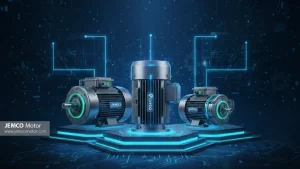
As one of the largest manufacturers of electric machines in the Middle East, GEMCO meets the infrastructure needs of the country’s parent industries not only by producing standard motors, but also by specialized production of high-pressure motors, explosion-proof motors, and special motors. The quality of GEMCO’s products fully complies with international standards and competes with leading global models in terms of reliability. This is a great advantage for industries for which maintaining stability and minimizing production line downtime is vital.
Expert View: When choosing a domestic supplier like Gemco, it is not just about price; it is also about ensuring quick access to technical support, reverse engineering, and spare parts in emergencies, which significantly reduces operational risks.

Key Benefits and Applications of Jamco Electric Motors
Gemco electric motors have outstanding competitive advantages due to their precise engineering and high-quality raw materials:
High efficiency classes (IE3 and IE4): Emphasis on producing motors with superior efficiency that minimizes energy consumption in the long term.
High Reliability: use of high-quality materials and standard industrial bearings to ensure long life under heavy loads.
Voltage diversity coverage: offering motors from LV (low voltage) to HV (high voltage), covering a wide range of industrial needs.
Environmental resistance: production of special models such as explosion-proof motors, vibration motors, and motors suitable for corrosive environments.
Comparison of energy consumption and the impact of efficiency class on costs
| Efficiency class name Approximate efficiency (example: 75 kilowatts) Impact on electricity costs | |||
| IE1 standard efficiency 85% high operating cost | |||
| IE2 high efficiency 88% moderate savings | |||
| IE3 premium efficiency 90% significant savings (global standard) | |||
| IE4 ultra-premium efficiency 92% maximum savings and high economic justification |
5 Vital Points Before Buying a Jamco Electric Motor (Technical Selection Guide)
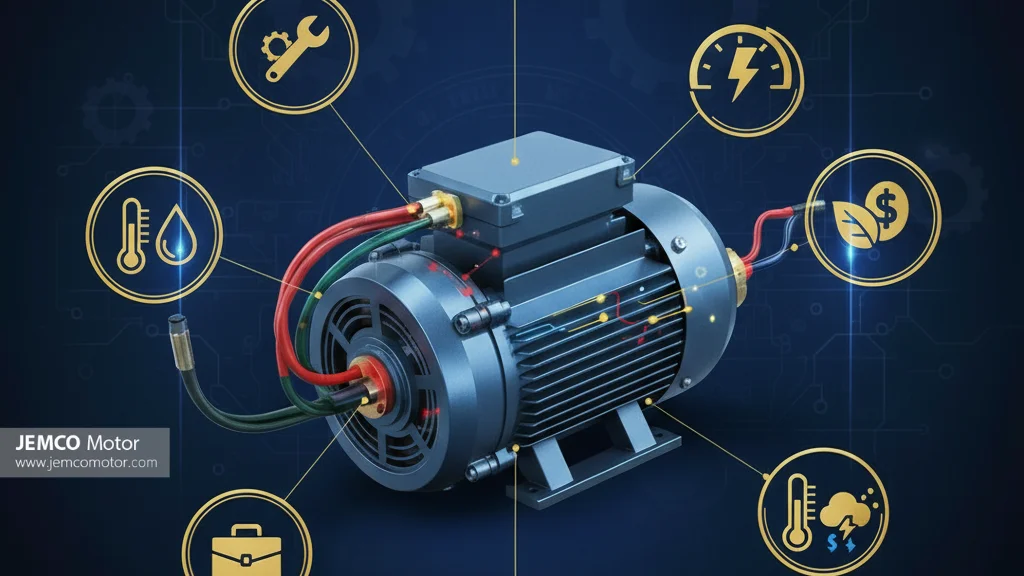
To ensure proper and optimal motor performance, the process of purchasing a Jamco electric motor must be based on precise technical calculations:
Tip 1: Pay attention to the efficiency class (IE1 to IE4) and its impact on TCO
Total Cost of Ownership (TCO): An industrial electric motor consumes more than 95% of the TCO in the form of energy costs over its lifetime, and only 5% of it is related to the initial purchase cost. Therefore, purchasing an IE3 (Premium Efficiency) or IE4 (Super Premium Efficiency) motor, despite the higher initial price, will save millions of tomans in electricity costs in the long run.
Note 2: Degree of protection (IP) and environmental requirements
The IP (Ingress Protection) rating is defined by two digits (for example, IP55):
First digit (5): Protection against solid objects and dust (5: complete protection against dust, 6: complete and sealed protection).
Second digit (5): Protection against liquids (5: strong water spray, 6: heavy splashes and 7: temporary immersion). Choosing the right IP is crucial for environments with high humidity or dust and directly affects the life of the bearings and windings.
Note 3: Output power, service factor (SF) and mechanical load
Rated power: It is the power that the motor can provide continuously and without damage.
Service Factor (SF): This factor (usually 1.15) indicates how much additional load the motor can handle for a limited period of time. If your load has momentary peaks, you should choose a motor with an appropriate SF or choose a motor that will be underloaded at rated conditions.
If you are looking for high-efficiency motors for industrial use, purchasing an AC electric motor from Gemco could be an ideal option. These motors are manufactured to high quality standards and are suitable for a variety of industrial equipment such as production lines, pumping, and ventilation.
Note 4: Frequency, number of poles (RPM) and types of inertial loads
The engine speed (RPM) must match the required speed of the coupled equipment (pump, fan, gearbox).
Motors with more poles (6 or 8 poles): lower speed (1000 and 750 rpm), higher starting torque, suitable for high inertia loads (such as mixers or grinders).
Motors with fewer poles (2 or 4 poles): Higher speed (3000 and 1500 rpm), suitable for pumps and fans. So to see the types of Jamco AC motors in different powers, click here.
Tip 5: Installation method (IM Code) and the importance of dynamic balance
IM Code (International Mounting Code) is a standard for determining the type of motor mounting (e.g. B3, B5, V1). The correct choice of mounting type ensures that the coupling of the motor and the mechanical load is carried out accurately and without mechanical stresses. Also, the dynamic balance of the motor, especially in medium and high pressure motors, must be carried out at a high level to minimize the vibration of the motor during operation and increase the life of the bearings.
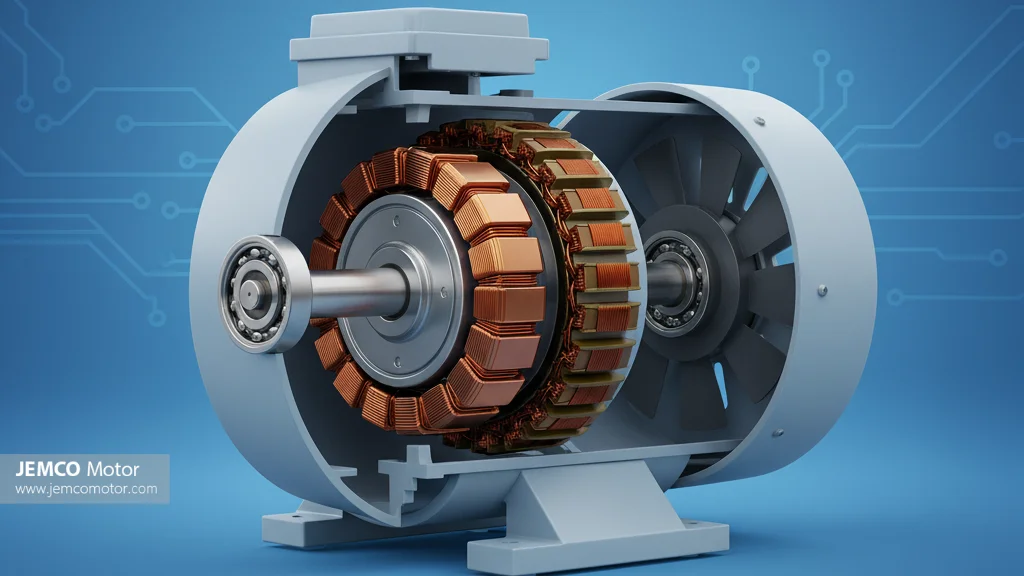
Main structure (stator, rotor, housing, bearings and fan)
The technical specifications of the Jamco electric motor clearly indicate the quality of the parts used:
Bearings: Usually selected from reputable global brands to withstand radial and axial loads. Bearings are the main cause of motor failure; therefore, their quality and appropriate type (such as insulated bearings in MV motors) are crucial.
Fan and Cooling System (IC Codes): Motors are often designed with a total cooling system (such as IC411). It is very important to ensure that the motor fan is adequate for your operating ambient temperature.
Important technical indicators (current, voltage, power factor and insulation class)
Insulation Class: This class (such as F or H) determines the resistance of the windings to heat. Class F withstands up to 155°C and Class H withstands up to 180°C. Using a higher insulation class (H) in hot environments increases the life of the motor.
Power Factor ($\cos\phi$): A low power factor indicates inefficiency in energy consumption and the need for compensation equipment (such as capacitors) in the network. Jamco motors, with their optimal design, provide an acceptable power factor.
The role of the electric motor frame (cast iron and aluminum) in durability
Aluminum frame: lighter, better heat transfer, suitable for low power and public environments.
Cast iron frame: heavier, higher mechanical resistance, reduced vibration, suitable for high power and harsh, corrosive or vibrating industrial environments.
Types of Jamco Electric Motors: Comprehensive and Specialized Classification
1. Classification based on operating voltage
This is the main category, defined based on the motor input voltage level, and has a direct impact on the insulation design and motor power.
A. Low Voltage (LV) Electric Motors
These motors are the most widely used type in the industry.
Voltage: Up to 1000 volts (the most common working voltages in Iran include 380 volts, 400 volts, and 660 volts).
Power: From low powers (usually 0.55 kW) to medium and high powers (up to about 200 kW).
Typically of the squirrel-cage type and often manufactured with cast iron or aluminum frames.
Application: The most common applications include all types of pumps, fans, small compressors, conveyors, and general industrial machinery.
Distinctive feature: Design in accordance with high efficiency standards (IE2, IE3 and IE4).
B. Medium and High Voltage (MV & HV) Electric Motors
These motors are designed to transmit high powers and reduce current losses over long distances.
Voltage: Above 1000 volts (common voltages include 3.3 kV, 6.6 kV, and 11 kV).
Power: In the high power range (from several hundred kilowatts to several megawatts).
Structure: Has a more complex insulation structure with resistant insulation materials (such as resin/mica systems) to withstand high electrical stress.
Application: Main and vital drives in heavy industries such as power plants, petrochemicals, refineries, cement and metal smelting (such as large process compressors, boiler fans and huge pumps).
Distinctive feature: The need for more advanced protection and monitoring systems and design for high starting torque.
2. Classification based on application and installation environment (Specialized Motors)
In addition to standard engines, Gemco produces specialized models for specific environments and unique technical requirements.
A. Explosion-Proof (Ex) Electric Motors
Definition: Engines designed to operate in environments with flammable gases, vapors, or explosive dust (Zoned Areas).
Structure: The housing of these engines is reinforced in such a way that if an explosion occurs inside the engine, it releases flames and hot gases in a controlled and cooled manner to prevent the external atmosphere from igniting.
Application: Oil, gas and petrochemical industries, mines, chemical warehouses and other hazardous environments.
Distinctive feature: Has international standard certificates such as ATEX and IECEx.
B. Special and customized electric motors
Gemco has the ability to design and manufacture engines with specific technical specifications, including:
Vertical Motors: For driving deep and vertical pumps.
Water and high humidity resistant motors: with a very high degree of protection (IP) (such as IP66 or IP67) for wet or wash environments.
Dahlander motors: Two-speed motors that allow the motor speed to be changed by changing the windings.
Motors with non-standard technical specifications: Manufacturing motors with specific voltages or frequencies according to customer orders.
3. Classification based on structure and technology
This category is more related to how the engine works internally.
A. Squirrel-Cage Induction Motors
Technology: The most common type of AC motor across all voltage levels. Their rotor is made up of copper or aluminum bars that resemble a squirrel cage.
Features: Easy to build, high durability, low maintenance and good efficiency.
B. Wound Rotor Induction Motors
Technology: The rotor of these motors is wound, allowing an external resistor to be connected to the rotor circuit to control starting torque and speed.
Application: Where very high starting torque and limiting starting current are required (such as heavy cranes or mills).
In environments where flammable gas or dust is likely to be present, the use of explosion-proof motors is essential. To ensure the safe and stable operation of equipment, you can view the price of explosion-proof electric motors and different models and choose the most suitable option.
Summary and conclusion of the types of Jamco electric motors:
| Classification criteria for electric motor type Working voltage Main application | |||
| Low voltage (LV) working voltage below 1 kV (e.g. 380V) General industrial applications | |||
| Medium and high voltage (MV/HV) working pressure above 1 kV (e.g. 6.6KV) heavy industries and power plants | |||
| Application of explosion-proof (Ex) LV and MV properties in hazardous environments (oil, gas, petrochemical) | |||
| Squirrel cage structure LV and MV All standard applications | |||
| LV and MV winding rotor structure Heavy loads requiring high starting torque |
Key points in the purchasing process, guaranteeing authenticity, and inquiring about the price of Jamco electric motors
Approvals and Certificates: When purchasing a Gemco electric motor, especially for explosion-proof motors, be sure to request the necessary certificates (such as ATEX or IECEx) and approval from the manufacturer to ensure the authenticity of the product.
Nameplate reading: Before purchasing, it is essential to accurately read the motor’s nameplate and match it to the project requirements (voltage, rated current, efficiency class, frequency, and IP).
Price Inquiry: Due to changes in raw materials (copper, steel) and currency market fluctuations, the price of Jamco electric motors is variable. To receive the latest price and official pro forma invoice, apply directly through reputable channels.
Final Conclusion and Practical Steps for a Successful Choice
Choosing and purchasing a Jamco electric motor is a strategic decision that directly affects the energy efficiency and durability of your industrial processes. By focusing on the efficiency class (IE3 and above), the degree of protection (IP appropriate to the environment) and the precise matching of power and speed, you ensure a smart and long-term investment. Jamco, backed by in-house technical knowledge and global standards, is a reliable choice for the driving heart of your industry.